According to the central limit theorem, if the sample size is large enough, the distribution of sample means of the same size tends toward a normal distribution regardless of the shape of the population distribution. The arithmetic mean of all sample means is the population mean and is denoted by µ. The standard deviation of the distribution of sample means is the standard error of the mean and is denoted by σx̄ (SE, the standard error of the mean).
Based on this, the position of the arithmetic mean of a particular sample, just as for individual results in the distribution, can be expressed via z values. The modified formula for calculating the z value is

From the formula, we can see that z is equal to the quotient of the difference between the arithmetic mean of the sample and the arithmetic mean of the population and the standard error of the arithmetic mean. This formula can also be expressed as

Based on the z-value, it is possible to determine the probability of obtaining that sample mean, using standard normal distribution tables.
In the social sciences, the z-test for a sample mean is rarely used, because the population standard deviation is usually unknown, so the t-test is used instead. This text will use it to explain one-tailed versus two-tailed hypothesis testing.
One-tailed null hypothesis testing
One-tailed hypothesis testing is used when testing a directional alternative hypothesis.
If we set the directional hypothesis with α=0.05, the cutoff value is z=1.65; above z=1.65 lies the 5% rejection region, which represents the probability of obtaining such an extreme sample mean by chance if the null hypothesis were true.
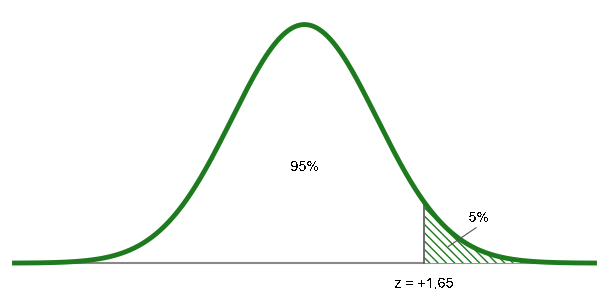
If we set the directional hypothesis with α=0.01, the cutoff value is z=2.33; above z=2.33 lies the 1% rejection region, which represents the probability of obtaining such an extreme sample mean by chance if the null hypothesis were true.
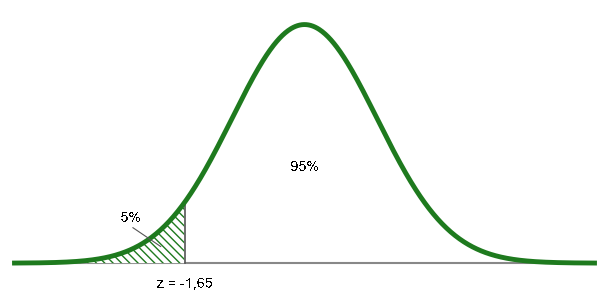
A directive hypothesis can also test negative or bad results. In this case, for α=0.05 the cutoff value is z=-1.65, and for α=0.01 the cutoff value is z=-2.33. Below the cutoff value is the rejection region for the null hypothesis H0 (i.e., the region supporting the alternative hypothesis Ha), and above it is the region where the null hypothesis H0 is retained.
Two-tailed null hypothesis testing
Two-tailed hypothesis testing is used when testing a non-directional alternative hypothesis. Two-tailed hypothesis testing is also recommended in situations where there is suspicion of negative consequences of the treatment being tested.
If we opt for α=0.05 and two-tailed hypothesis testing, then the 5% total area under the normal curve should be divided by two (0.05/2=0.025). This means that the area under the curve where the null hypothesis is accepted is between -1.96 and 1.96. Below and above that area is the range of validity of the alternative hypothesis Ha.

If we choose α=0.01 and two-tailed hypothesis testing, then the 1% total area under the normal curve should be divided by two (0.01/2=0.005). This means that the area under the curve where the null hypothesis is accepted is between -2.58 and 2.58. Below and above this area is the range of validity of the alternative hypothesis Ha.
The disadvantage of two-tailed versus one-tailed testing is that a stronger result is needed to reach significance. A result with a z-score of 1.67 would be significant in one-tailed testing, but would not be significant in two-tailed hypothesis testing at α=0.05. From the table of areas under the normal curve, we see that the probability that z=1.67 is 0.9525, which means that the area above this result is p=0.0475. Since p<0.05, the result is statistically significant in a one-tailed test. This result is not significant in a two-tailed test at α=0.05, because the two-tailed p-value is 2×0.0475=0.095, which is greater than 0.05 (the z-score of 1.67 also fails to exceed the two-tailed critical value of 1.96).
 alternative hypothesis


Comments (0)